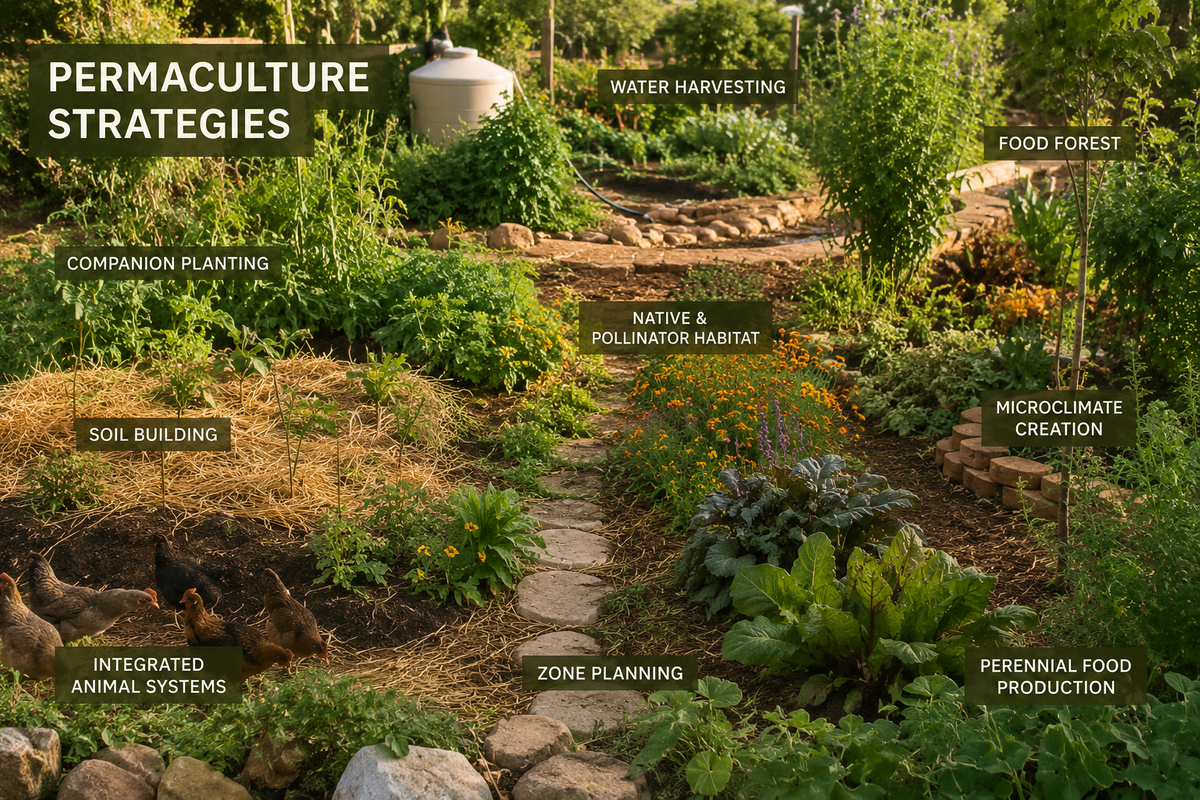
Healthy ecosystems are the foundation of productive gardens, farms, ranches, and landscapes. When soil, water, plants, animals, fungi, and people work together as an interconnected system, landscapes become more resilient, abundant, and capable of thriving with fewer external inputs.
Permaculture provides a practical framework for designing these living systems by observing natural patterns and applying strategies that regenerate the land while meeting human needs. Instead of working against nature, permaculture helps create landscapes that become healthier, more productive, and easier to maintain over time.
What Makes an Ecosystem Thrive?
Healthy ecosystems share several key characteristics:
Healthy, living soils
Efficient water cycling
Diverse plant and animal communities
Beneficial relationships among plants, fungi, microorganisms, and wildlife
Natural nutrient cycling
Unlike conventional landscapes that often rely on fertilizers, pesticides, and frequent maintenance, natural ecosystems function because each element supports many others. Every plant, animal, and microorganism contributes to the health and resilience of the whole system.
Permaculture seeks to replicate these natural relationships by designing landscapes that are productive, self-sustaining, and regenerative.
Water Comes First
In New Mexico and other dryland regions, water is the single most important factor influencing ecosystem health.
Successful permaculture design begins by understanding how water moves across a property and implementing strategies that maximize infiltration, storage, and efficient use.
Key Water Management Strategies
Passive rainwater harvesting
Swales, basins, berms, and other earthworks
Deep mulching and living ground covers
Building soil organic matter
Efficient irrigation systems
Rainwater storage and reuse
Slow it. Spread it. Soak it. Store it.
Capturing rainfall where it falls helps recharge soil moisture, reduce erosion, support healthier plants, and build long-term drought resilience.
Build Healthy, Living Soil
Healthy soil functions like a sponge—capturing water, storing nutrients, and supporting billions of beneficial soil organisms that sustain plant life.
As soil health improves, landscapes become more productive while requiring less irrigation, fewer amendments, and significantly less maintenance.
Strategies for Building Living Soil
Compost application
Deep mulching
Cover cropping
Reduced or no-till management
Livestock integration
Diverse plant communities
Inoculating soils with beneficial soil microorganisms
Healthy soil is one of the most valuable investments you can make in the long-term success of your landscape.
Increase Biodiversity
Diversity is one of nature's greatest strengths.
Landscapes filled with a variety of plants, pollinators, birds, beneficial insects, fungi, and soil organisms are naturally more resilient to pests, disease, drought, and environmental stress.
Permaculture Designs Often Include
Native plants
Pollinator habitat
Edible trees and shrubs
Medicinal plants
Living ground covers
Windbreaks
Wildlife habitat features
The result is a vibrant landscape that supports both ecological function and human needs.
Design Every Element to Perform Multiple Functions
One of permaculture's guiding principles is that every element should serve multiple purposes.
Examples
Trees provide:
Food
Shade
Wildlife habitat
Wind protection
Carbon storage
Soil improvement
Chickens provide:
Eggs
Pest control
Food waste recycling
Natural fertilizer
Garden cultivation
Rainwater harvesting basins provide:
Rainwater infiltration
Erosion control
Soil moisture recharge
Plant irrigation
Wildlife habitat
By stacking functions, landscapes become more efficient, resilient, and productive.
Choose Plants That Belong
Selecting plants adapted to local conditions dramatically improves long-term success.
Native, naturalized, edible, medicinal, and drought-tolerant species typically require less water, fewer inputs, and less maintenance while providing greater ecological value.
In New Mexico, thoughtful plant selection helps create landscapes that thrive despite heat, wind, alkaline soils, limited rainfall, and temperature extremes.
The right plants work with your environment instead of fighting against it.
Reduce External Inputs
A well-designed permaculture system minimizes dependence on synthetic fertilizers, herbicides, pesticides, and excessive irrigation.
Instead, fertility is created through natural processes such as:
Composting
Mulching
Nutrient cycling
Plant diversity
Healthy soil biology
Rainwater harvesting
These regenerative strategies lower long-term costs while creating healthier environments for people, pets, pollinators, livestock, and wildlife.
The Power of Observation
Every successful permaculture project begins with careful observation.
Before making design decisions, it's important to understand:
Climate
Soil conditions
Water movement
Sun exposure
Wind patterns
Existing vegetation
Wildlife
Opportunities and constraints
Rather than forcing the landscape to fit a preconceived design, permaculture works with natural processes to create solutions uniquely suited to each property.
How Vital Soil Landscapes Can Help
At Vital Soil Landscapes, we help homeowners, businesses, farmers, ranchers, nonprofits, and public organizations create beautiful, productive, climate-adapted landscapes that improve year after year.
Our Services Include
On-site consultations
Regenerative landscape design
Rainwater harvesting and water-wise solutions
Living soil strategies
Educational workshops and training
Whether your goal is growing food, harvesting rainwater, restoring degraded land, improving wildlife habitat, or creating a healthier and more resilient property, we develop practical solutions that work with nature—not against it.
Create a Landscape That Grows Better Every Year
The healthiest landscapes are not maintained through constant intervention—they are designed to function as living ecosystems.
As soil improves, water cycles become more efficient, biodiversity increases, and natural processes take over much of the work traditionally done through fertilizers, pesticides, and intensive maintenance.
That's the power of regenerative design.
If you're ready to transform your property into a thriving ecosystem, Vital Soil Landscapes can help.
Schedule a consultation today and begin designing a landscape that conserves water, builds healthy soil, supports biodiversity, and grows more abundant with every passing year.
Frequently Asked Questions
What is ecosystem design in permaculture?
Ecosystem design is the process of creating landscapes where soil, water, plants, animals, and people function together as an integrated, self-supporting system.
Why is water the first priority in New Mexico?
Because water is the primary limiting factor in dryland environments. Capturing and infiltrating rainfall improves soil health, reduces erosion, supports plant growth, and increases drought resilience.
What are the benefits of a permaculture landscape?
Permaculture landscapes typically:
Use less water
Require less maintenance
Build healthier soils
Support biodiversity
Produce food and habitat
Improve resilience to drought and climate extremes
Does permaculture work for residential landscapes?
Absolutely. Permaculture principles can be applied to properties of every size—from urban backyards to large farms and ranches.