University students today are studying some of the most difficult challenges New Mexico will face in their lifetimes: drought, water scarcity, declining soil health, extreme heat, biodiversity loss, food-system vulnerability, and the need to build communities that can adapt to a changing climate.
But there is an important question we should be asking alongside all that study: Are we giving students enough opportunities to learn how to design solutions?
As a permaculture designer, regenerative farmer, landscape professional, and educator who is teaching permaculture at the University of New Mexico, I see tremendous opportunity for students to complement their academic education with practical design skills they can carry into their careers.
UNM and NMSU are moving in this direction. For example, UNM's UNM Sustainability Studies Program emphasizes combining critical inquiry with effective action, while its new Sustainability Corps gives students paid, hands-on experience working on campus sustainability projects. UNM’s 2025–2030 Sustainability Strategic Plan also recognizes that students increasingly expect sustainability to be connected to their education, values, and future careers.
A Permaculture Design Certificate, or PDC, can be another bridge between understanding environmental problems and developing the capacity to address them.
Permaculture is bigger than gardening
People sometimes hear “permaculture” and think vegetable gardens, compost piles or fruit trees. Those can certainly be part of it, but permaculture is fundamentally a holistic systems-based design approach to address any and all challenges related to human civilization.
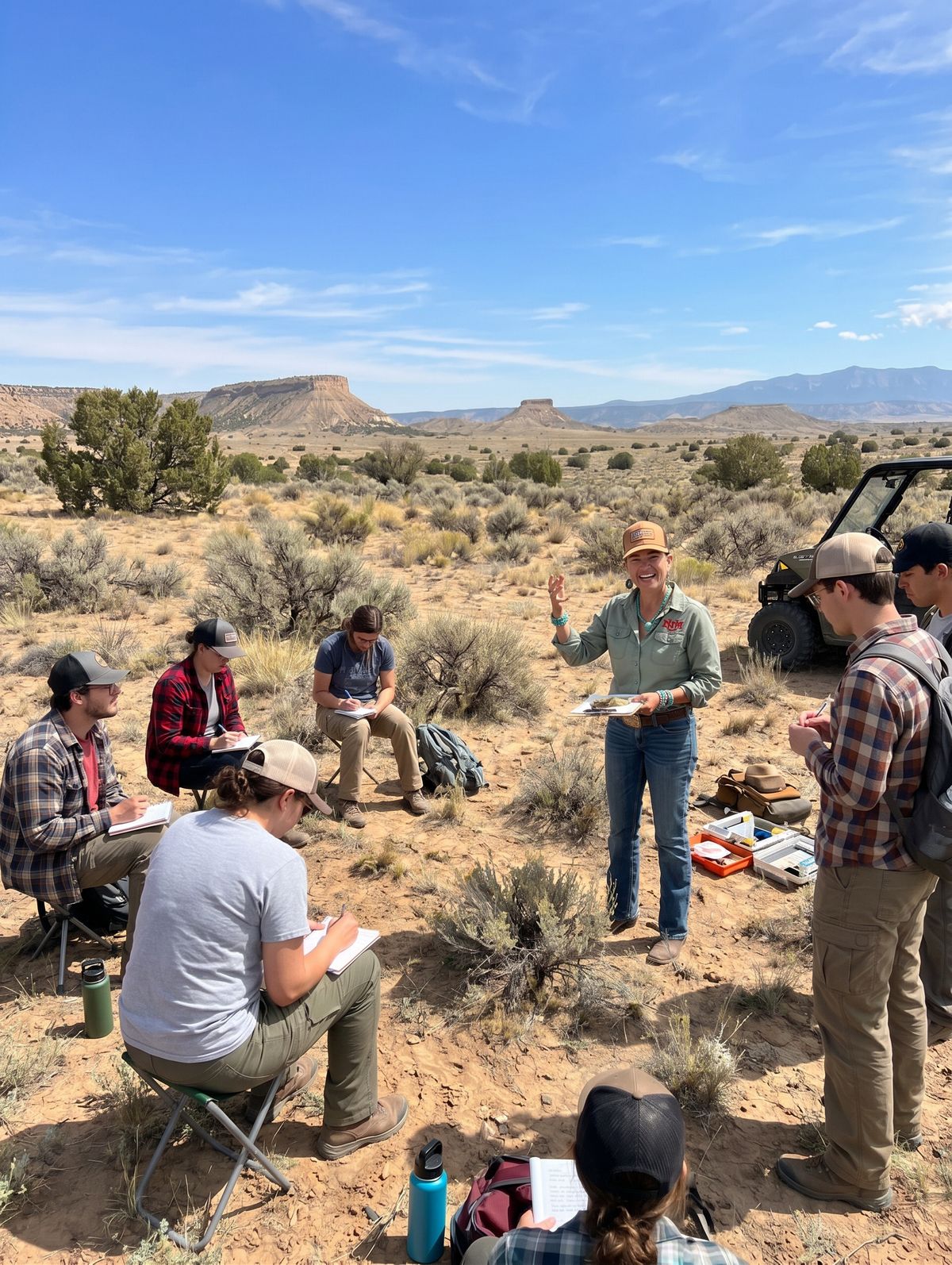
Students learn to observe a site before deciding what should happen there. They examine how water moves, how soil functions, where sunlight and shade fall, how wind affects a landscape, how plants and wildlife interact, what resources are available, and how people use a place.
Instead of immediately asking, “How do I make this landscape do what I want?” we learn to ask, “What is already happening here, and how can I design with those natural processes?”
That shift in thinking matters far beyond landscaping.
It teaches observation, systems thinking, problem solving, resourcefulness and the ability to recognize relationships between seemingly separate problems. Those are useful skills whether a student eventually works in conservation, agriculture, planning, landscape design, sustainability, education, government, nonprofit work or community development.
A career advantage for students
A college degree provides an essential academic foundation. A PDC can complement that education with something students frequently tell me they want more of: practical experience applying ideas to real places and real problems.
Imagine an environmental science student who not only understands watershed processes but can look at a property and begin identifying opportunities to slow, spread and infiltrate stormwater.
Imagine a biology student who understands ecology and can also think about designing plant communities that provide food, habitat, pollinator resources and soil-building functions.
Or an architecture or planning student who can incorporate water harvesting, microclimates, food production, biodiversity and regenerative landscape systems into the way they think about the built environment.
These connections are particularly relevant in New Mexico.
UNM and NMSU and other already offer sustainability-focused internships and experiential learning with organizations working in sustainability, resilience and regeneration. Its Sustainability Studies minor explicitly combines academic work with internships, community projects and hands-on action.
Permaculture fits naturally into that movement toward applied learning.
What students actually learn
A comprehensive PDC like the one I am offering with Jeremiah Kidd of San Isidro Permaculture in April 2027 can introduce students to soil health and soil biology, rainwater harvesting, food production, plant guilds, perennial systems, regenerative landscaping, ecological restoration, climate-responsive site planning, natural building and small-scale agriculture. See details here: https://www.facebook.com/share/19hV3ddGcP/
But learning individual techniques isn't really the point.
The deeper skill is learning how to design.
Students learn to read a landscape, identify opportunities and constraints, understand relationships among different elements, establish priorities and develop solutions appropriate to a particular climate, community and site.
That ability to move from observation → analysis → design → implementation can be extraordinarily valuable professionally.
New Mexico needs people who can do this work
The career opportunity extends well beyond becoming a “permaculture designer.”
Students can carry these skills into regenerative agriculture, horticulture, landscape design, conservation, ecological restoration, land management, sustainability, environmental planning, education, consulting, community development and public service.
UNM's own sustainability initiatives illustrate how broad this field has become. The university's Sustainability Corps works in areas including food systems, ecological services, waste reduction and community engagement, while UNM's sustainability programs connect students with government agencies, nonprofits and other organizations working on environmental and community challenges.
A PDC alone does not guarantee someone a job, nor should it be presented as a substitute for a university degree or specialized professional credentials.
What it can provide is a design framework, practical vocabulary, hands-on experience and portfolio-building opportunities that help students translate what they are learning academically into work they can demonstrate.
For some students, that may complement an existing career path. For others, it may open possibilities they had never considered: starting a regenerative landscape practice, working on farms or restoration projects, teaching, consulting, designing food-producing landscapes or integrating ecological design into another profession.
From concern to capability
Many students I meet already care deeply about climate change and environmental degradation.
What they need is not another reason to be worried.
They need opportunities to develop the confidence that comes from knowing how to do something.
Permaculture gives students a place to begin.
A degraded patch of soil can become an opportunity to rebuild biological life. A roof can become a water-harvesting surface. Stormwater can become a resource. A conventional landscape can become pollinator habitat. An ornamental yard can also produce food. A difficult site can become a design challenge.
That is a powerful transition—from studying problems to designing solutions.
And it is one reason I am excited to be teaching permaculture at UNM.
Your education can become something you put into the ground
Students should leave college knowing more than what is wrong with the world. They should have opportunities to practice creating what could replace it.
Permaculture perfectly answers this call address through teaching how to observe carefully, think in systems, work across disciplines and turn knowledge into action.
Your landscape can become your classroom.
Your university education can provide the scientific and intellectual foundation.
Your practical skills can help turn that knowledge into a career.
And your career can become part of building a more water-wise, productive and resilient New Mexico.
For UNM students wondering what comes after graduation, that is an opportunity worth exploring.
Ready to move from studying problems to designing solutions? Vital Soil Landscapes offers hands-on permaculture, water-wise and regenerative landscape workshops including a PDC in April 2027 for students and the wider community.
Explore upcoming Vital Soil Landscapes workshops and register for the PDC: vitalsoillandscapes.com/education.
Learn. Design. Create. Regenerate.